
Size of steps
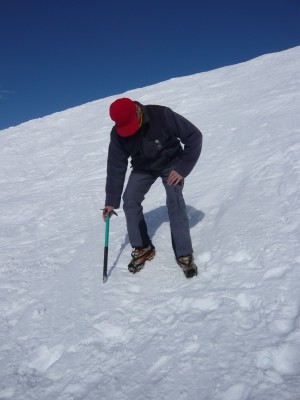
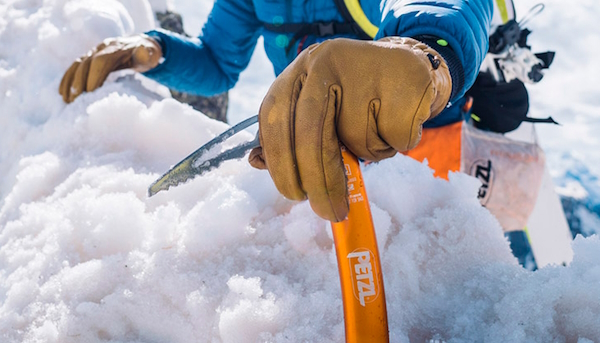
The use of crampons has consigned the tedious chore of trimming steps to oblivion. Sometimes, however, you find yourself without crampons on snow that’s too hard or on ice, or you come up against a steep passage on an easy run. In these cases, you use your ice axe to carve out the few steps that will allow you to continue safely.
Before you start carving, take a good look at the terrain to determine its weak points and force your way through with the minimum number of steps. Keep your balance so that you can carve with precision and a minimum number of ice axe strokes.
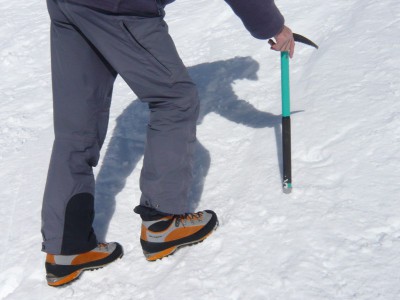
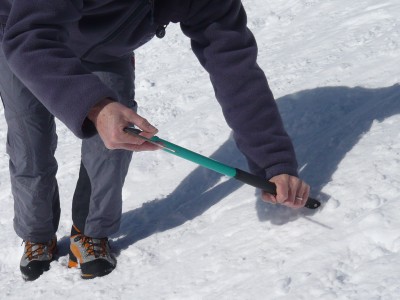
You carve using the pick and the bit of the ice axe. It is best to hold the pick close to the socket with both hands.
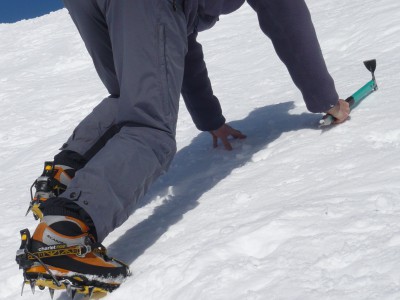
If the slope is steep, you cut with one hand (the downstream hand), the other hand resting against the slope or holding on to a grip previously cut into the ice.
On very steep slopes, it’s sometimes a good idea to lean your leg and knee up against the slope to maintain your balance.
It’s important to remember that precision of stroke is more important than strength. You need to practise using both your right and left hands. On the way down, the steps will be closer together than on the way up.
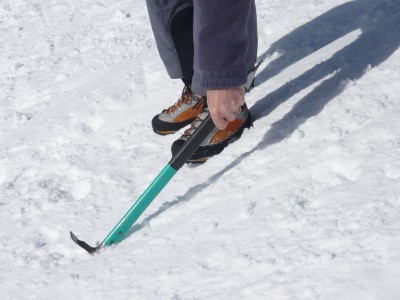
In very hard snow, it is often best to cut notches for the sole ‘in stride’, i.e. at the same pace as you walk. The advantage of this method is twofold: speed and less effort.
The ice axe is held in one hand; the head of the ice axe is made to describe a pendulum movement so that the bit attacks the snow almost tangentially, one stroke of the ice axe is enough to cut a notch. By synchronising the movement of the arm with that of the step, you can cut a small step just in front of the foot that will be placed in it.